Recap: Sheep Creek Stewardship Project field tour
By Katy Nesbitt, NBFC Board Chair
Sometimes, a walk in the woods requires tall boots, or even waders - and sometimes forest restoration goes beyond the trees. The Sheep Creek Stewardship Project in the upper Grande Ronde River watershed is multifaceted - combining improved fish and wildlife habitat, floodplain reconnection and a landscape more resilient to wildfire on land managed by the Wallowa-Whitman National Forest and the Bureau of Land Management.
Former La Grande District Ranger Bill Gamble said, “We asked ourselves if we wanted to be more aggressive at reducing fuels than just hand piling. We decided we wanted riparian health included in the purpose and need in areas of the project where it made sense.”
Thinning trees along streams and rivers is not typical; fish-bearing streams need to be cool and tree-shade helps keep temperatures low. However, encroaching conifers like lodgepole pine can out-compete deciduous, riparian vegetation like alder and willow.
Gamble said the project area was deemed “functioning at risk” - meaning the ecosystem needed help to support its fish, wildlife and plant communities. The project sought to keep water temperatures cool, add riparian vegetation, improve fish passage, decrease road sediment and manage wildlife exclosures protecting growing vegetation from deer and elk.
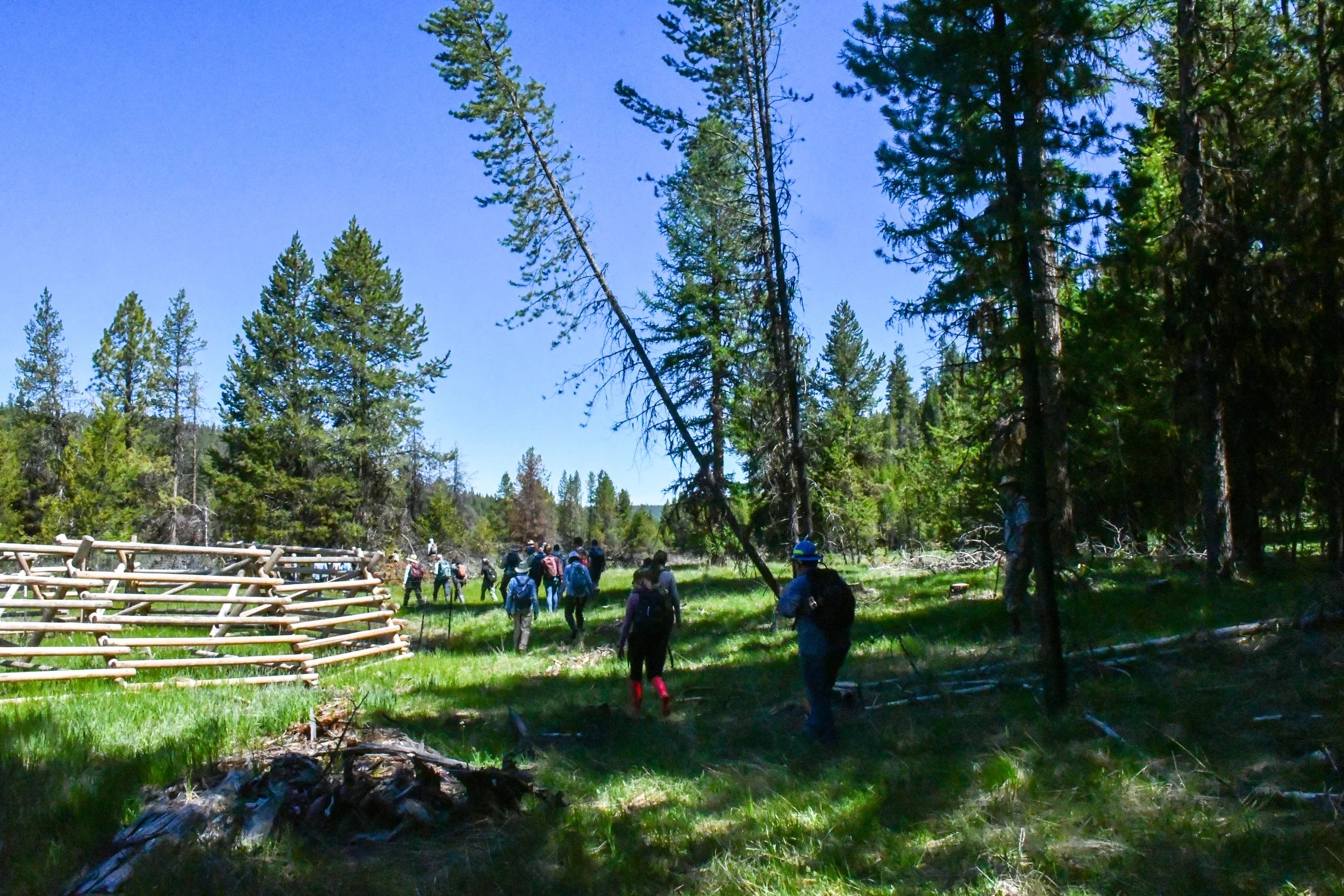
Ungulate exclosures, like the buck-and-pole fence pictured here, protect newly planted riparian vegetation from grazing.
“Our Legacy Funds proposal was successful and paid for work on fish passage and resurfacing the road,” Gamble said. It also addressed upland habitat.”
Besides Chinook salmon, steelhead and rainbow trout, Gamble said fish and wildlife species like Pacific lamprey, dace and sculpin, Columbia spotted frog, great grey owls, native freshwater mussels and crawfish all live within the project area.
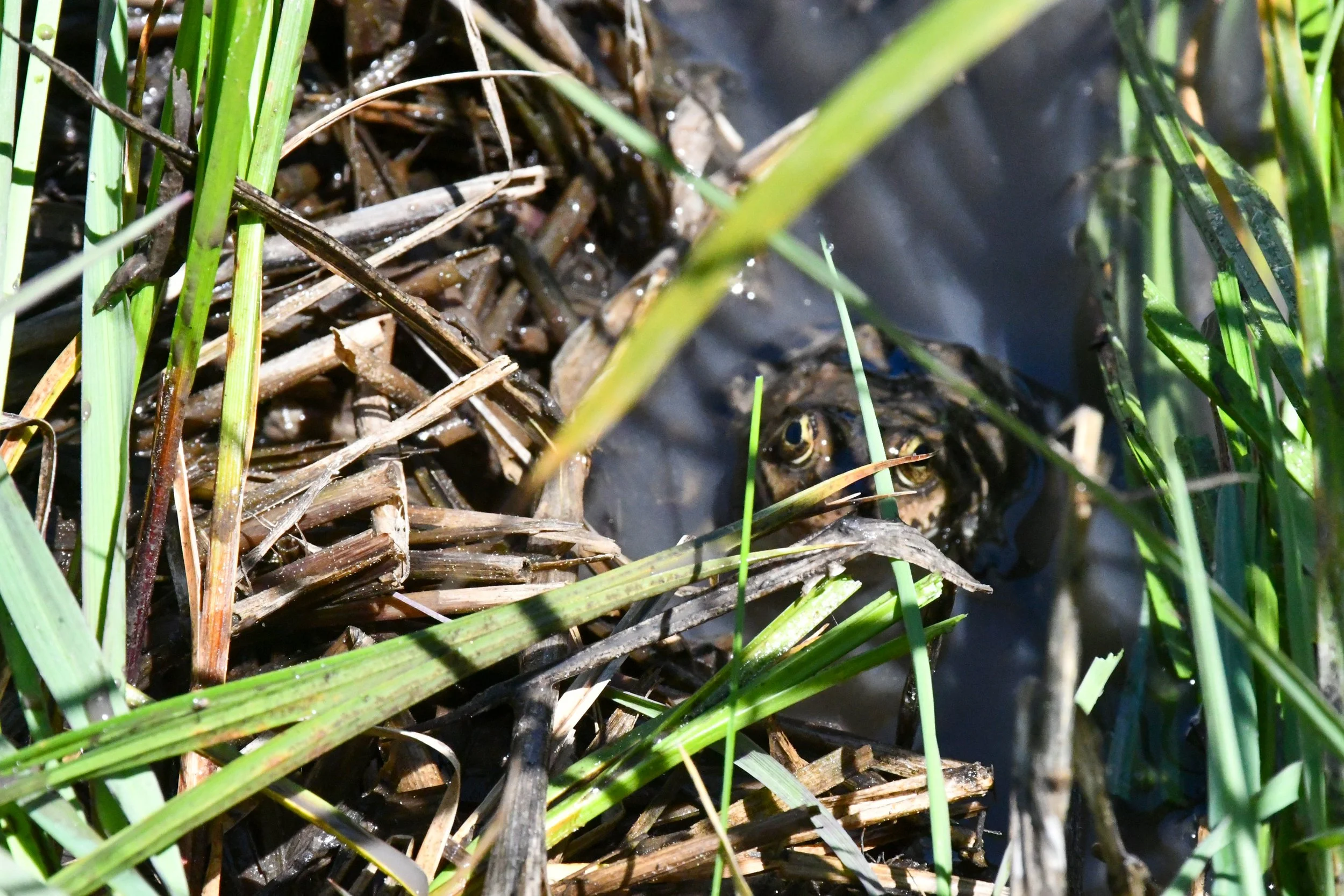
With restoration efforts in the Sheep Creek area, there is now increased habitat for the Colombia spotted frog.
Over the course of many years, Sheep Creek became a sub-watershed project - more comprehensive than typical projects focused more on either the upland or aquatic environments.
Levi Old, the Northeast Oregon Restoration Director for Trout Unlimited, said that over the ten years 18,000 plants were planted, five culverts replaced, large wood and beaver dam analog structures installed in the floodplain, and straight channels that allowed swift water were re-designed, leaving more resting areas for fish.
“Every year we are doing something - planting, fencing or thinning conifers,” Old said. “Within the systems there is a lot of overlap - they are intertwined.”
That overlap complicated the project design and slowed down the consultation process with the regulatory agencies - National Marine Fisheries and U.S. Fish and Wildlife Service - but the members of the project team decided it was worth the wait.
Sarah Brandy, Fisheries Program Manager for the Wallowa-Whitman National Forest, has been involved in the Sheep Creek Project since 2016. She said, “We took a hard look at the landscape and what the needs were. There are many acres in the Blue Mountains like this - we wanted to go beyond the riparian area and do a deeper analysis. We were committed to pushing the envelope and, with our ranger’s support; we turned a corner on managing the riparian.”
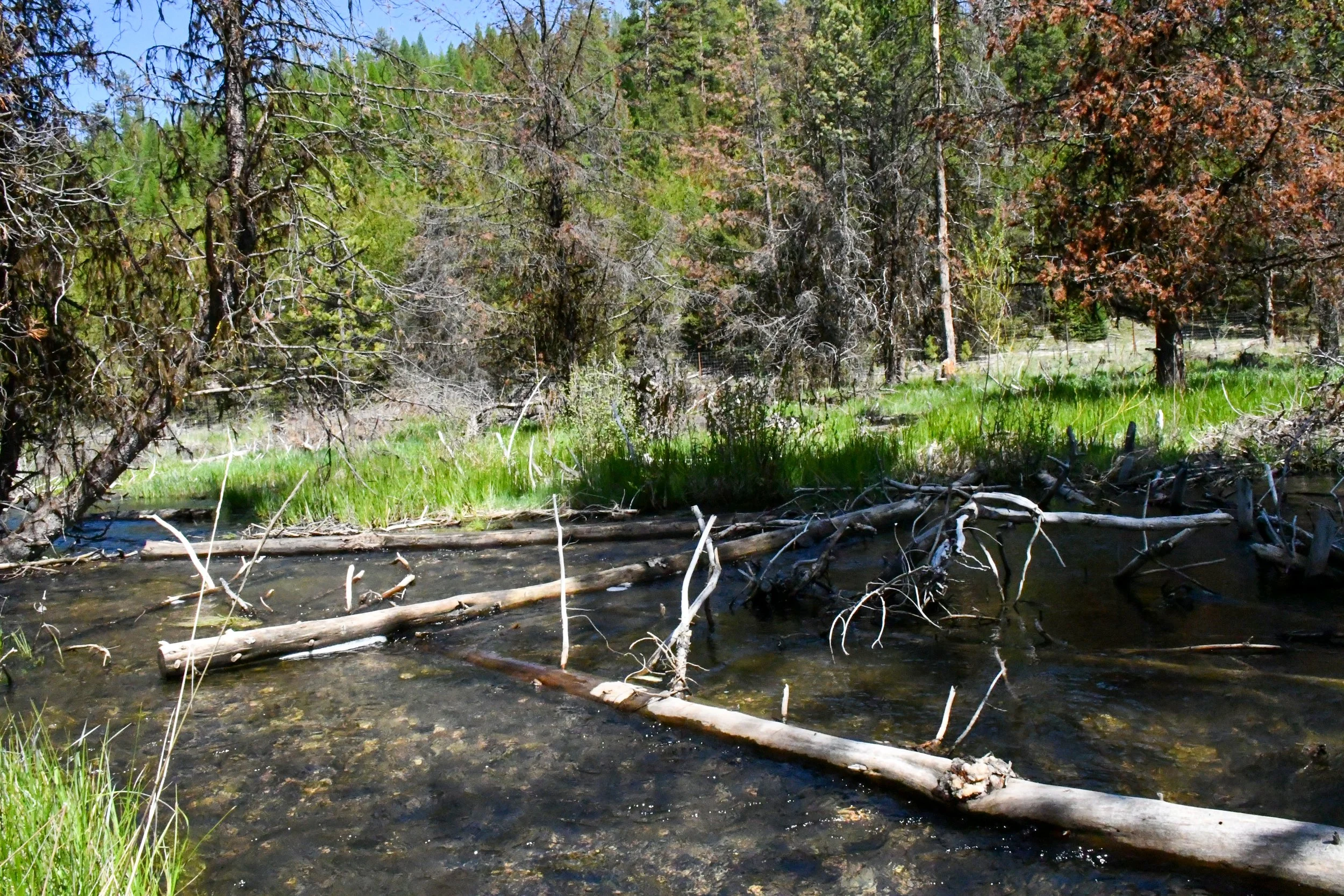
Thinned lodgepole pine were left onsite to help redistribute water in the Sheep Creek floodplain.
Combining a vegetation-focused project with benefits for fish and wildlife is not unique, but the integration of the two on Sheep Creek provided opportunities to reduce fuels that Lucas Glick, La Grande District silviculturist, said presented a “significant risk for high intensity fire.” Within the 35,000-acre project area 12,000 acres were thinned for forest health and to provide strategic fuel breaks, Glick said. A commercial timber sale of 1,700 acres will be sold later this summer.
Instead of piling and burning all of the lodgepole near the creek, Glick said some was fallen and left onsite to disperse the energy of the creek, distribute the water into the floodplain and to recharge the groundwater.
The Blue Mountains are also home to large game - primarily elk and mule deer - who need access to water and food sources as well as forest cover that provides safety from predators. While fish habitat and passage were crucial to the project, Glick said Sheep Creek connected habitat for both aquatic and terrestrial wildlife.
“This project connects the two matrices - we are missing the mark if we don’t provide connectivity corridors.” Glick said.

Grande Ronde Basin rivers restored through public/private/tribal partnerships
The rivers and streams of the northern Blue Mountains are home to thousands of species. Restoring these vital waterways to their natural channels and floodplains improves habitat for fish and wildlife as well as their human neighbors.
By recreating natural features and processes, river restoration projects encourage rivers once constrained by development to reconnect with historic courses that can be seen in aerial photos from the early and mid-twentieth century. Some projects show benefits quickly with more fish utilizing restored pools, added woody debris and spawning gravels, while other benefits will take time.
By Katy Nesbitt, NBFC Board Chair
The rivers and streams of the northern Blue Mountains are home to thousands of species. Restoring these vital waterways to their natural channels and floodplains improves habitat for fish and wildlife as well as their human neighbors.
By recreating natural features and processes, river restoration projects encourage rivers once constrained by development to reconnect with historic courses that can be seen in aerial photos from the early and mid-twentieth century. Some projects show benefits quickly with more fish utilizing restored pools, added woody debris and spawning gravels, while other benefits will take time. As stream and river channels are reconnected with floodplains, riparian vegetation will begin to flourish and groundwaters will recharge, helping restore wetlands supporting Columbia spotted frog, red winged blackbirds and a host of other wildlife.


Over the last twenty years both public and private land managers partnered with fish and wildlife specialists, tribes, engineers, and construction contractors to re-meander straightened channels, reconnect side channels, plant diverse vegetation and bury logs with their roots jutting into the water to create pools and hiding places for juvenile fish. The results - healthier rivers with improved conditions for aquatic and wetland species and less loss of soil through sediment washing into the streams.
Funding from federal and state agencies and nonprofit organizations, and private landowners is leveraged with fish and wildlife mitigation money from Bonneville Power Administration which uses a portion of hydroelectric dam rate payer fees to fund restoration benefitting threatened and endangered species like chinook salmon. These funds are focused on actions to help mitigate the impact of the dams on the Snake and Columbia Rivers on Chinook salmon and other endangered species with much of the restoration work completed by local contractors.
Sarah Brandy oversees river restoration on the Wallowa-Whitman National Forest. She said, “There’s been a lot of effort on the Upper Grande Ronde, John Day and Wallowa rivers to offset impacts from dams. A lot of our stream restoration funding implements recovery for endangered fish like steelhead, Chinook salmon and bull trout.”
Projects on the La Grande Ranger District like Bird Track Springs and Sheep Creek, along with the proposed Meadow Creek project at the Starkey Research Station, restore rivers and streams previously altered for highway and railroad construction and cultivation of farmland.
Brandy said, “Most of the work we do in the Grande Ronde Basin is in the headwaters. There is a lot of science that supports the idea that restoring functions in the headwaters will create a positive cumulative impact on downstream water users.”

The Colobmia spotted frog is one of the many species that benefits from reconnected floodplains and aquatic restoration.
When possible, projects on the national forest and private land are co-stewarded with local Tribes. Katie Frenyea, watershed manager for the Nez Perce Tribe’s Joseph Office said within the Tribe’s 13-million-acre treaty territory, land ownership varies widely, spanning tribal, federal, state and privately-owned lands.
Frenyea said that similarly to civilizations throughout the world, the majority of human development, and thus private property within the Tribe’s treaty area, is concentrated along the rivers and adjacent valley bottoms. Improvements to fish passage, juvenile rearing, and adult spawning opportunities are often most effective when restoration efforts are focused within these populated river corridors.
Another reason for a focus on private land comes from the Wallowa and Upper Grande Ronde ATLAS Restoration Prioritization Framework designed by the Bonneville Power Administration. Most of the top priority projects identified by ATLAS are on private land and working with landowners, Frenyea said, benefits both fish habitat and private land management.
“The application of a roughened channel design, which has been widely implemented to restore fish passage at irrigation diversions and other structures on the Lostine and Wallowa rivers, not only results in improved aquatic passage but can also enhance reliability and efficiency of irrigation water delivery,” Frenyea said.
Motivation for landowners, outside of an altruistic effort to improve ecological functions and fish and wildlife habitat, varies. Sometimes losing acreage to erosion, flash flooding, or allowing the river to move where it chooses, attracts private landowner attention.
Within the city limits of Lostine, the river was previously straightened to mitigate flooding in the 1960s. Over the years, the Lostine River has eaten away so much land it created a cliff, imperiling a private property. John Nesemann, a landowner in the river bottom, said “Bank armoring in the 60s proved unsustainable and the river created a gorge.”
Following many years of planning, relationship building, and engineering, Frenyea and her colleague, watershed restoration specialist - Montana Pagano, oversaw a project that drastically changed the course of the river. Their work divided the channel it in two to spread out the energy eating away at the river’s eastern bank, moving the river into former channels, reconnecting the river with its floodplain and expanding the adjoining wetland.
John and Val Nesemann have lived on the river since 1998. Despite losing five acres to the river project, they could see the value the restoration would afford their neighbors to the east. They had also seen the success of the first river restoration in the Wallowa Valley on Doug McDaniels’ ranch in the mid-2000s. They understood that the river wanted to move.
Shortly after the project was completed, the river eased into the newly dug channels, moving away from the cut bank on the eastern shore.“The river wanted to come this way,” Val Nesemann said.

John and Val Nesemann collaborated with other neighbors, including the Pierri’s, to accomplish a large river restoration project along the Lostine River.
In all, 11 properties were involved in the restoration, with a bulk of it on the Nesemanns and their new neighbors, Anna and Joe Pierri, whose involvement made the design easier and added amenities - like better river access. “The river restoration made the landscape more dynamic and interesting and we gained an extra river,” Joe Pierri said.
“Wherever the river goes now, there is a place for it,” Anna Pierri said.
To learn more about river restoration efforts in the Northern Blues, email or for information on upcoming tours and webinars sponsored by the Northern Blues Forest Collaborative, email nbfc@wallowaresources.org.

Prescribed fire season brings restoration to the Northern Blues
It’s springtime and smoke is in the air as landowners and managers take advantage of seasonal weather conditions to reduce fuels and improve forest and range health with prescribed fire.
While most private landowners primarily burn ditches, fields and piles of brush, there is an increasing desire to burn sizable chunks of ground. To support this movement, a partnership between Oregon Department of Forestry and OSU Extension developed a program called IGNITE Prescribed Burn Skills Training to provide hands-on training to diverse participants, including Certified Burn Manager trainees, anyone else who wants to learn about fire ecology and science, prescribed fire unit layout, firing and holding techniques, monitoring weather, and operating pumps and fire engines.
By Katy Nesbitt, NBFC Board Chair
It’s springtime and smoke is in the air as landowners and managers take advantage of seasonal weather conditions to reduce fuels and improve forest and range health with prescribed fire.
While most private landowners primarily burn ditches, fields and piles of brush, there is an increasing desire to burn sizable chunks of ground. To support this movement, a partnership between Oregon Department of Forestry and OSU Extension developed a program called IGNITE Prescribed Burn Skills Training to provide hands-on training to diverse participants, including Certified Burn Manager trainees, anyone else who wants to learn about fire ecology and science, prescribed fire unit layout, firing and holding techniques, monitoring weather, and operating pumps and fire engines.

Attendees at the first NE Oregon IGNITE training learn from experts how to dig line on a prescribed fire.
The IGNITE training was open to anyone interested and held in early June on a private ranch owned by Peter Ferre’. He said he’d been aware of the power and relevance of prescribed fire as a tool, like timber harvest and thinning and offered his land for the training.
Ferre’ said, “I’ve worked really hard to manage the fire risk on my timber land, but the way I’m managing the fire risk is like sitting on a two-legged stool and the third leg necessary is prescribed fire.”
Ferre’ said he has long researched the uses and benefits of prescribed fire, understanding the risks - and the smoke. Recently, he said he witnessed some aspects of fire that took his understanding beyond the papers and articles he read.
“Four to five years ago we had a small, unintended fire at the ranch,” Ferre said. “Since then, the positive impact on that little stand of timber is amazing - how well it cleaned up the understory of that little area, and since then I’ve walked that hill and I have oregon grape, serviceberry wild rose, strawberry and other native plants that were not there previously, flourishing”
The discovery of Medusahead rye on his ranch is one more reason Ferre’ said he is eager to use fire as a land management tool. For this and some other specific species, specific timing/use of prescribed fire can kill seeds and reduce re-establishment. “My desire is to have the ranch be a place for learning,” Ferre’ said. “I’ve benefited so much from this ground that I’d like it to benefit others.”
Understanding the relationship between fire and land management is a keen interest of Micah Schmidt, OSU Extension regional fire specialist, who said one of the benefits of prescribed fire is restoring the human relationship with fire.
“For more than 100 years fire has been seen as destructive, and people who have lived through a wildfire have trauma and fear the next wildfire,” Schmidt said. “Seeing prescribed fire on the land can help the healing process.”

Over 70 partners in the Northern Blues came together last fall to learn more about prescribed fire implementation and participate in a small burn.
Despite the fear and trauma, Schmidt said, humans have evolved to use fire to manage their land and in turn, their food sources. “Like many cultures in the world, we still like fire in some way,” Schmidt said, “and when you put a drip torch in someone’s hands, they get excited.” A drip torch is one of the ignition devices used in prescribed fire. It uses a diesel and gasoline mix of fuel and when the wick of the metal can is lit, the operator walks along igniting fine ground fuels like grass, dead twigs and small limbs.
Carefully returning fire to the ecosystem, especially over hundreds and thousands of acres, is part of restoring natural processes. Low and moderate severity fire cleans up pockets of dead wood, reduces encroaching trees and brush and can help protect and promote older, large trees and those best adapted to surviving wildfires, like the ponderosa pine and Western larch. This is considered best practice for land managers today when it comes to using fire as a management tool, and a growing and evolving practice adopted by agencies following large conflagrations like the 1988 Yellowstone National Park fires.
“As we head into fire season, we’re focused on safety, readiness, and interagency coordination,” said Jess Bohnsack, Fire Management Officer for the Wallowa-Whitman’s North Zone for the Wallowa-Whitman National Forest. “With hazardous fuels build-up across the West and here locally, treating more acres is better than treating fewer to achieve our goals."
The goals when using prescribed fire are varied depending on the project including objectives that benefit forest health by reducing the risk of wildfire destroying large swaths of trees and sensitive species as well as protecting and improving wildlife habitat.

A broadcast prescribed burn in the Lower Joseph Creek Project on the Wallowa-Whitman National Forest in April 2025.
Todd Pedersen, the North Zone’s assistant fire management officer who focuses on prescribed fire, said some vegetation is adapted and responds well to burning. While some species are more fire resilient, like ponderosa pine, removing some of the understory also benefits the larger landscape. Pedersen said, “If we are trying to mimic nature, some of our fires not only reduce fuel loading, but support fire expressing itself on the landscape with many results.”
Most of the trees killed in a prescribed fire are small in diameter, but occasionally larger trees die, leaving a “snag” - a desirable dead tree - that is an underrepresented habitat for woodpeckers, nuthatches, bluebirds and owls as well as raccoons and squirrels.
After a prescribed fire some vegetation, like lodgepole pine regenerates, while others, like the wood lily, thrive. Resilient shrubs and other forage become more accessible and palatable for deer, elk and cattle after a low or moderate intensity fire.
Oregon Department of Forestry fire crews don’t typically manage large-scale understory prescribed fires, but are called on to burn large slash piles, another type of prescribed fire, on private industrial timber land or support crews like The Nature Conservancy who support burning on federal, tribal, and private lands. Department of Forestry fire crews are often called to back up Forest Service and Bureau of Land Management crews as well when they burn public forest and range land.
Whether prescribed fires are lit by federal agencies or private landowners, the Department of Forestry helps monitor and mitigate smoke emissions along with the Oregon Department of Environmental Quality. ODF Wallowa Unit Forester Tracy Brostrom said, “We encourage landowners to turn in a smoke management plan so the state knows how much smoke is going to be in the air.”
Along with smoke management, careful planning, coordination of resources, weather observations, and monitoring after the fire ensures prescribed fire can continue to be a safe and effective tool for managing healthy landscapes.
Forest Collaborative in the News
The Northern Blues Forest Collaborative aims to be a space where diverse stakeholders in our public lands can come together and discuss challenging, and sometimes controversial, topics. Through these discussions we hope to help inform planners, practitioners, and implementors as they move forward with projects in our public spaces.